
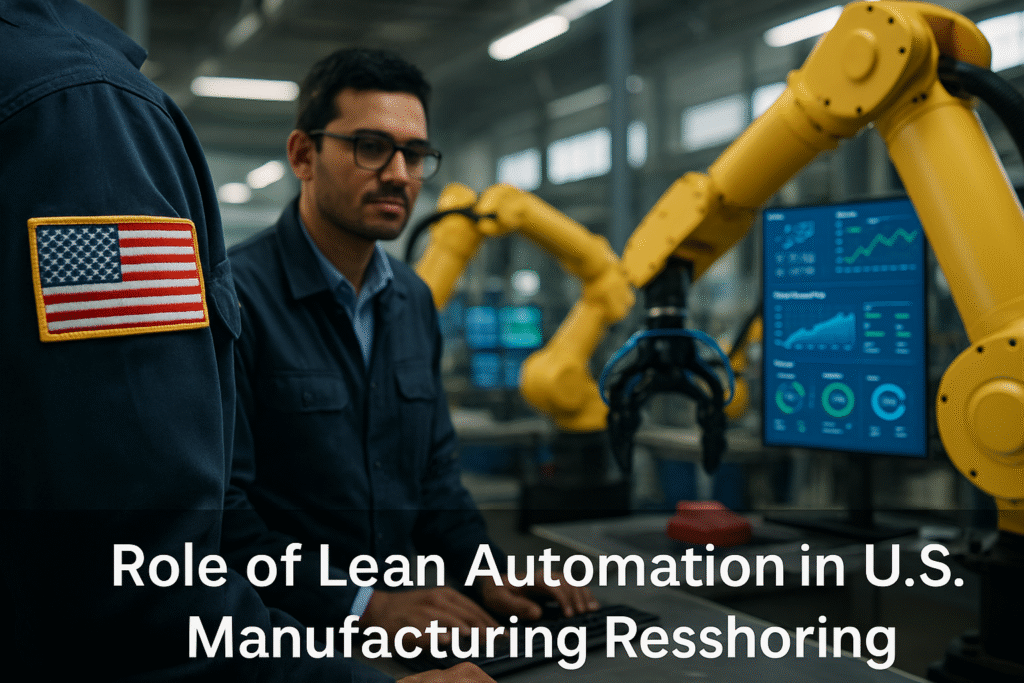
As global supply chains face increasing instability, U.S. manufacturers are rethinking their dependency on overseas production. Disruptions from pandemics, geopolitical tensions, and rising freight and labor costs have exposed the vulnerabilities of offshoring. In response, reshoring — the strategic move to bring manufacturing back to U.S. soil — is gaining momentum. Central to this revival is lean automation: the powerful fusion of lean manufacturing principles and smart automation technologies. Together, they offer a competitive edge that allows U.S.-based factories to match or even outperform their offshore counterparts in efficiency, quality, and cost-effectiveness.
Lean automation doesn’t just mean adding machines to the factory floor — it’s about rethinking processes from the ground up. Lean methodologies such as Kaizen (continuous improvement), value-stream mapping, and 5S enable manufacturers to identify waste, optimize workflows, and empower teams. When these principles are combined with technologies like AI-driven scheduling, automated material handling, and real-time monitoring systems, the results are transformative. Manufacturers can now produce more with fewer resources, reduce lead times, and adapt quickly to changing demand — making reshoring economically viable.
Md. Ashraful Azad, a strategic manufacturing expert with over 11 years of experience, exemplifies this transformation. Currently pursuing his M.Sc. in Industrial Engineering at Lamar University, his research focuses precisely on the intersection of lean automation and U.S. reshoring. His professional track record — from reducing costs through strategic vendor negotiations to leading ERP-driven production teams — demonstrates the operational advantages that lean automation delivers. By combining his field experience in textile and apparel supply chains with his scholarly insights, Ashraful provides a practical roadmap for how U.S. factories can implement these strategies and thrive domestically.
A major advantage of lean automation in the reshoring context is labor productivity. With smart automation handling repetitive or precision-heavy tasks, skilled U.S. workers can focus on higher-level functions such as quality control, equipment optimization, and process innovation. This shift not only drives output but also creates better-paying jobs and boosts employee satisfaction. Additionally, automation minimizes the risk of production delays due to labor shortages or turnover — common challenges in both domestic and overseas operations.
Cost competitiveness is also enhanced. While U.S. labor rates are typically higher, lean automation narrows the gap by eliminating non-value-added steps, minimizing rework, and optimizing equipment usage. Technologies such as programmable logic controllers (PLCs), AI-driven quality inspection, and digital dashboards enable real-time performance tracking and fast decision-making. As shown in Ashraful’s research on “Advanced Lean Manufacturing and Automation for Reshoring American Industries,” these systems reduce waste, energy consumption, and material loss — directly improving margins.
In the context of sustainability, lean automation also supports the environmental goals that many reshoring companies prioritize. Smarter production lines consume less energy and produce fewer emissions, while lean practices reduce overproduction and material waste. Combined, they help manufacturers align with U.S. federal sustainability goals and ESG requirements, giving reshoring initiatives both regulatory and reputational advantages.
In summary, lean automation is not just an operational strategy — it’s a national imperative. As reshoring continues to reshape American industry, leaders like Md. Ashraful Azad are showing how data-driven, human-centered manufacturing models can deliver long-term success. By integrating lean principles with cutting-edge automation, U.S. factories can achieve world-class performance without relying on offshore production, reclaiming global competitiveness in a more resilient and sustainable way.